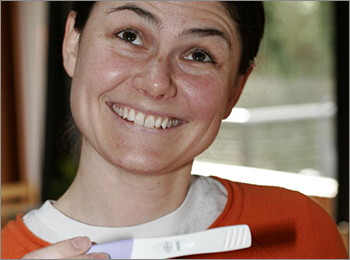
Tracey was ecstatic; she had just taken a home pregnancy test and the result was positive. Tracey had been longing for a baby for some time, but had put it off, because she was concerned about juggling motherhood with work. A few months ago, Tracey had read a magazine article about fertility in couples of “advancing age”, which referred to the declining incidence of pregnancies as the age of couples increased. This had shocked Tracey and, although both she and her partner, Ian, were only 30-years-old, she became worried about “leaving it too late”. Ian agreed and they planned to start a family. Tracey stopped using the contraceptive pill and started to pay more attention to when her periods were, so that she could be more aware of when she was likely to ovulate. Tracey also read a leaflet on preparing for a healthy pregnancy that suggested she should take folic acid from before conception and in the first 12 weeks of pregnancy to encourage the healthy development of the baby. The leaflet mentioned that this recommendation was supported by valid and reliable clinical research. After 3 months, Tracey had a positive pregnancy test.
Now that she was pregnant, Tracey talked with her mum, Linda, about pregnancy and birth. Tracey had been born at home, but didn’t know whether home births were supported for women nowadays. Her friend’s baby had been delivered by caesarean section and Tracey wondered why people made the choices they did about where and how to have their baby. Linda reassured Tracey that she was there to support her and Tracey thought how important having her mum would be.
Whilst Tracey was happy she was pregnant, she wasn’t looking forward to the tiredness, indigestion and constipation that her mum warned her to expect. Sore breasts and feeling sick were bad enough.
Tracey called into her local GP surgery and an appointment was made for her to see the midwife. She discussed staying healthy in pregnancy and gave Tracey a set of maternity notes, which detailed information about her pregnancy and appointments. There was a lot to think about. The midwife also arranged for Tracey to have an ultrasound scan at the hospital at 12 weeks.
The letter about the scan advised Tracey to attend with a full bladder, which was a struggle. The ultrasound scan showed that the baby was developing normally so far. The sonographer also checked Tracey’s other pelvic organs and reassured her that the small cyst on the left ovary was ‘a collapsing corpus luteum’, which was a normal finding. The sonographer measured the size of the baby, which matched Tracey’s period dates. Both Tracey and Ian wanted to know the sex of the baby, but the sonographer explained that it was too early to see this at 12 weeks. The next scan was arranged for 20 weeks.
By 20 weeks, Tracey’s nausea had gone and she was feeling much better. The scan, which took much longer this time, examined the structure of the baby in a lot of detail, including closely examining the heart, nervous system, gut and urinary tract. Tracey was relieved to hear that the baby had developed normally and that she was having a baby boy. It was also at around this time that Tracey was very excited to feel the baby moving inside.
After this scan, the midwife arranged to see Tracey regularly. She checked Tracey’s blood pressure, urine and also measured the uterus to ensure that the baby was growing as it should be.
At 39 weeks, Tracey woke in the middle of the night with contractions. When they were coming regularly, approximately 3-4 minutes apart, Ian drove her to the hospital, where their baby boy was born. As soon as he was born, the midwife placed the baby onto Tracey’s abdomen and chest. Tracey and Ian were initially anxious, as the baby looked quite blue and did not cry straight away. The midwife dried him with a towel and reassured Tracey and Ian that “all was well”, as it takes a short amount of time for the baby to adapt to birth. Within a minute or two, he was crying vigorously.
Ian and Tracey were delighted and immediately rang their families with the exciting news.